2026 How to Choose Black Silicon Carbide for Your Needs?
Selecting the right Black Silicon Carbide for your specific needs can be a daunting process. Industry expert Dr. Emily Hawkins, renowned for her research in abrasive materials, once stated, "The choice of Black Silicon Carbide can significantly impact your project’s efficiency and quality." Her insights underline the importance of making informed decisions in this field.
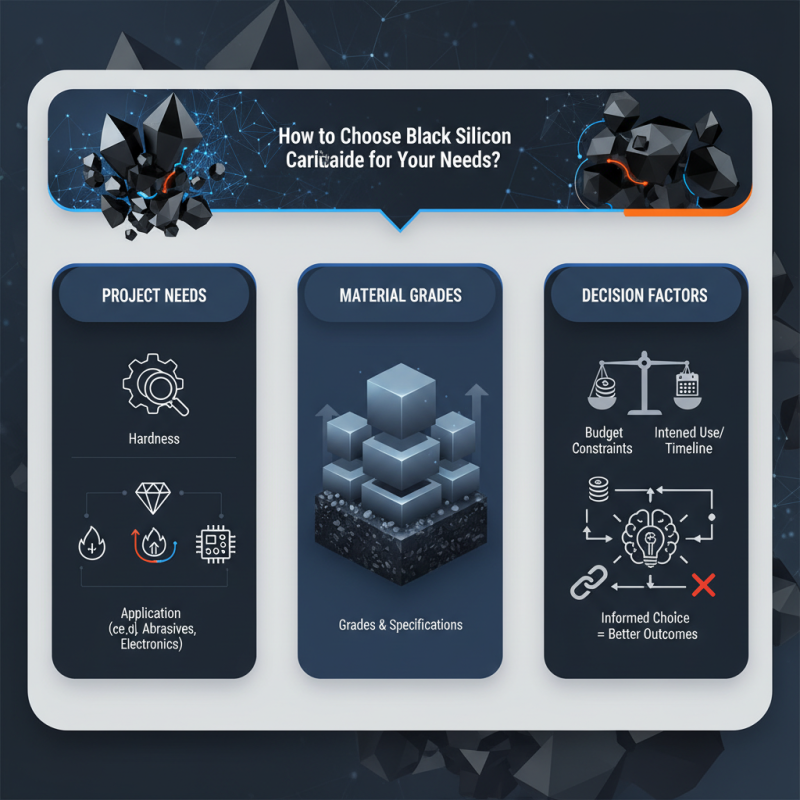
Black Silicon Carbide is a versatile material widely used in various applications, from abrasives to electronics. Understanding the unique properties that define this material is crucial. For example, its hardness and thermal conductivity make it ideal for specific tasks. Yet, not every type of Black Silicon Carbide is suitable for every application. There are different grades and specifications, each designed for unique purposes.
Navigating the market can sometimes feel overwhelming. Various suppliers offer diverse products with varying levels of quality. It is essential to analyze your project's specific needs, budget constraints, and the intended use of Black Silicon Carbide. Remember, an informed choice can lead to better outcomes, while a misstep may result in project delays or increased costs.
Choosing the Right Black Silicon Carbide: Key Considerations
Choosing the right black silicon carbide (SiC) is crucial for various industrial applications. With the growing demand for high-performance abrasives, manufacturers are now focusing on quality and source. According to industry reports, the global black silicon carbide market is projected to reach $1.5 billion by 2026, highlighting its significance.
When selecting black silicon carbide, consider the grit size. Smaller grit sizes provide finer finishes, while larger sizes offer more aggressive cutting capabilities. Additionally, assess the purity of SiC. High purity ensures better performance in demanding applications, reducing contamination risks. Key reports indicate that 98% purity levels can enhance mechanical properties significantly.
**Tips:** Always inquire about the sourcing process. Understanding where and how SiC is produced can reveal much about its quality. Testing samples in your application might expose potential shortcomings. Relying solely on supplier claims can be misleading.
In addition to grit size and purity, the intended application is vital. Different applications may require specific qualities, such as thermal conductivity or strength. Some processes may benefit from blends of silicon carbide grades. Research from the American Ceramic Society suggests that tailored compositions can improve efficiency in manufacturing processes.
Understanding the Applications of Black Silicon Carbide in Various Industries
Black silicon carbide (SiC) is increasingly relevant in various industries, from manufacturing to electronics. Its unique properties make it suitable for a wide range of applications. In the abrasive industry, black SiC is preferred for grinding, sawing, and polishing materials. According to market analysis, the global demand for abrasives is projected to reach $55 billion by 2024, driven by construction and automotive sectors.
In electronics, black silicon carbide is utilized as a semiconductor material. Its thermal conductivity, high electric field strength, and wide bandgap advantages contribute to efficient power devices. Reports suggest that the SiC semiconductor market will surpass $2 billion by 2025, emphasizing its growing significance in renewable energy and electric vehicles.
While the benefits are notable, challenges remain. The production of black silicon carbide can generate environmental concerns due to energy consumption. Understanding these trade-offs is essential for companies aiming to integrate SiC into their processes. Evaluating the lifecycle impact of black SiC can guide sustainable choices. Balancing performance with environmental responsibility is crucial as industries strive for innovation while minimizing their ecological footprint.
Evaluating the Grading Standards for Black Silicon Carbide Quality
When selecting black silicon carbide, it's vital to understand grading standards. Black silicon carbide is often used for various applications, from abrasives to ceramics. The quality of this material largely depends on its grading, which can vary significantly based on production methods and raw materials.
According to the American National Standards Institute (ANSI), black silicon carbide grades are classified by purity and particle size. Higher purity grades, such as those with 98% SiC content, are ideal for high-performance applications. Industry data indicates that lower purity can lead to reduced performance and durability. A study by the Global Ceramics Research Institute highlighted that inappropriate grading may affect the end product's strength and wear resistance, an aspect often overlooked by buyers.
Further complicating the choice is the variability in manufacturing processes. Some producers use less rigorous quality control, resulting in inconsistencies. An industry analysis noted that about 25% of black silicon carbide products do not meet industry standards. Buyers should be wary of such discrepancies. They may think they are purchasing quality materials, only to find they fall short in performance criteria. Always consider certifications and independent testing reports to ensure reliability.
2026 Black Silicon Carbide Quality Evaluation
This chart illustrates the quality scores of different grading standards for black silicon carbide, helping users evaluate which grade may best suit their needs. Higher scores indicate better quality in terms of purity and performance.
Comparing the Properties of Black Silicon Carbide vs. Other Abrasives
When comparing black silicon carbide to other abrasives, several key properties emerge. Black silicon carbide has a unique crystalline structure that gives it superior hardness. According to a report by the American Ceramic Society, its hardness is rated at approximately 9.2 on the Mohs scale. This outperforms aluminum oxide, which typically measures around 9.0. This hardness translates to better cutting efficiency and longevity, making it a preferred choice in many industrial applications.
Additionally, black silicon carbide's thermal conductivity is notable. It stands at about 120 W/m·K, significantly higher than that of aluminum oxide. This property allows for more efficient heat dissipation during machining operations. Enhanced thermal management can lead to increased operational life for both the tool and the workpiece. However, its brittleness may be a concern in certain contexts, which necessitates careful handling.
When deciding between abrasives for specific tasks, the chemical stability of black silicon carbide, especially in high-temperature environments, should be weighed against its brittleness. While it excels in abrasive applications, its tendency to fracture under stress can hinder its effectiveness in some situations. Careful evaluation of these properties is essential for optimal abrasive selection.
2026 How to Choose Black Silicon Carbide for Your Needs? - Comparing the Properties of Black Silicon Carbide vs. Other Abrasives
| Property |
Black Silicon Carbide |
Alumina |
Cubic Boron Nitride |
Diamond |
| Hardness (Mohs) |
9.0 |
9.0 |
9.5 |
10.0 |
| Fracture Toughness (MPa·m1/2) |
3.0 |
5.0 |
5.5 |
2.0 |
| Thermal Conductivity (W/m·K) |
120 |
30 |
30 |
200 |
| Typical Applications |
Glass, Ceramics, Stone |
Metal, Wood |
Advanced Materials |
Precise Cutting |
| Cost (per kg) |
$2.50 |
$2.00 |
$15.00 |
$60.00 |
Calculating Cost-Effectiveness: Analyzing Pricing Trends and Supply Data
When considering black silicon carbide, understanding pricing trends is crucial. Costs vary due to several factors. These include raw material availability and production methods. Analyzing market data reveals patterns. Prices can fluctuate based on demand and region.
Supply data also plays a key role. Global events often impact availability. For instance, geopolitical issues can disrupt production. This connection between supply and cost is worth examining. Companies need reliable sources to maintain their operations. However, not all suppliers adhere to the same standards. Quality assurance can sometimes lag behind financial considerations.
Budgeting for black silicon carbide requires careful analysis. Tracking historical pricing can help predict future trends. Yet, assumptions based on past data might mislead. Changes in technology can shift market dynamics unexpectedly. Reliability of suppliers varies; some might not deliver on time. Being proactive in understanding these details can save companies from costly mistakes.